Alocasia Dragon Scale Light Requirements
PlantLightIndex has not assigned an exact Alocasia Dragon Scale PPFD optimum. A broader 150–250 µmol/m²/s reference is shown only as context because the numerical evidence is not specific enough to become an exact target.
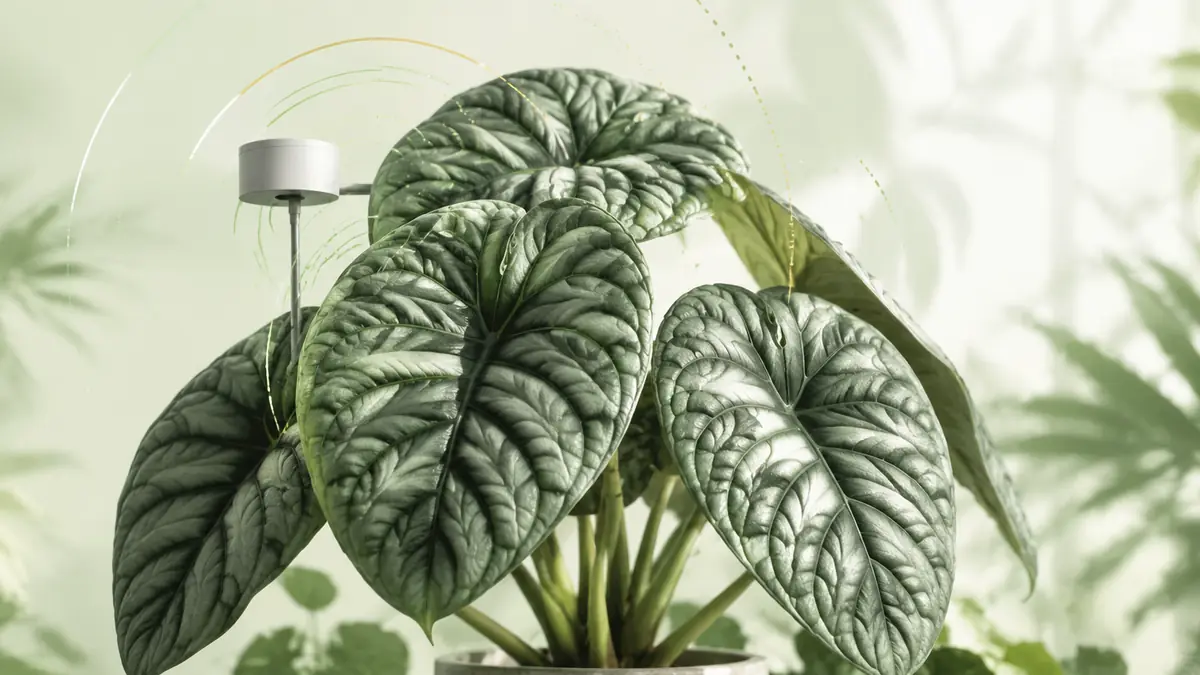
A 150–250 µmol/m²/s range is shown only as context.
How this light reference was determined
PlantLightIndex separates a practical household reference from physiology, survival trials and production conditions. For Alocasia Dragon Scale, the current recommendation basis is genus-level context, and the evidence scope is genus.
The page shows a numerical range only as context from a broader parent, species or genus reference. It is not presented as an exact target for this plant.
How much light does Alocasia Dragon Scale need?
PlantLightIndex has 150–250 µmol/m²/s as contextual guidance for Alocasia Dragon Scale.
Alocasia Dragon Scale is stored as the cultivar Dragon Scale under the accepted species Alocasia baginda. NC State also identifies the plant with that cultivar combination.
The current 150–250 PPFD range is broader Alocasia medium-light context, not an exact Dragon Scale cultivar optimum.
A practical range is a decision reference, not a promise of perfect growth and not a hard biological boundary. Plant response also depends on acclimation, leaf age, water availability, temperature, roots and other environmental conditions. The number is most useful when compared with a PPFD reading taken at the leaves.
Why PlantLightIndex shows 150–250 µmol/m²/s for Alocasia Dragon Scale
The current 150–250 PPFD range is broader Alocasia medium-light context, not an exact Dragon Scale cultivar optimum. On this page, that becomes a contextual comparison range rather than an exact target. The purpose is to tell users what the reviewed evidence can support, not to make the data look more complete than it is.
Alocasia Dragon Scale is stored as the cultivar Dragon Scale under the accepted species Alocasia baginda. NC State also identifies the plant with that cultivar combination. Search names and accepted taxonomy are stored separately so common horticultural wording can remain discoverable without changing the scientific identity. That is especially important when older names or cultivar labels remain common in retail listings.
How to measure Alocasia Dragon Scale at leaf level
Measure the newest active leaf and outer leaves across the compact rosette, especially under small spot-style grow lights where coverage can fall off quickly. PPFD should be measured at the foliage that is actually doing the current growth. Pot position, shelf height or room brightness can be misleading if the leaves sit somewhere else in the light field.
Take more than one reading when the plant has several leaves, a trailing habit or a directional window. Under a grow light, compare the centre with an outer leaf. Near a window, compare the glass-facing side with a shaded side. The goal is to understand the canopy, not to find the single highest number.
How natural window light changes the result for Alocasia Dragon Scale
Alocasia Dragon Scale can receive very different light from the same compass direction depending on hemisphere, season, distance from the glass, window size, exterior shade and filtering. A direction label is therefore a placement clue, not a measurement.
If direct sun reaches the foliage for part of the day, record when you measured. A reading taken during a brief sunbeam should not be multiplied across the entire daylight period as though intensity stayed constant. Natural-light DLI needs repeated measurements or a more sophisticated time-integrated estimate.
Grow-light decisions for Alocasia Dragon Scale should start with PPFD, not watts
Thick, textured leaves can reflect light differently to the eye, so perceived brightness should not replace a leaf-level PPFD measurement. When using a grow light, fixture wattage alone does not tell you the PPFD at the leaves. Beam angle, efficiency, optics, distance and dimmer setting all matter.
Start with a reasonable fixture height, measure several canopy points and adjust gradually. If the current record is contextual or qualitative, the calculator should preserve that uncertainty. A stronger light can be useful, but a precise distance recommendation is only justified when both plant target data and fixture measurement curves are available.
What does the PPFD reference mean for Alocasia Dragon Scale?
PPFD measures photosynthetic photon flux density in µmol/m²/s. It describes the photosynthetically active photons reaching one square metre each second, so leaf-level PPFD is more useful than room brightness when the question is how much plant-relevant light the foliage actually receives.
The evidence scope for this record is genus, and the calculator mode is contextual. A contextual record shows related numerical information without calling it an exact species- or cultivar-specific optimum.
No physiological saturation number is used as a household recommendation on this record.
Is 100 PPFD enough for Alocasia Dragon Scale?
PlantLightIndex cannot classify 100 PPFD as an exact optimum for Alocasia Dragon Scale because the current numerical range is contextual rather than plant-specific.
That answer still needs daily duration. PPFD is instantaneous. A plant receiving 100 PPFD for six hours does not accumulate the same daily photon total as a plant receiving 100 PPFD for twelve hours. DLI is used to describe accumulated daily exposure.
Do not apply 100 PPFD as a universal houseplant benchmark. Some species in the database use lower practical ranges, some use higher ranges, and some have no defensible numerical target. Start with the exact species or cultivar record instead of one generic number.
DLI for Alocasia Dragon Scale: what is known?
PlantLightIndex has not established a species- or cultivar-specific target DLI for Alocasia Dragon Scale in the current reviewed dataset. The site can calculate your DLI from PPFD and hours, but it will not call that value optimal or deficient without a supported plant target.
DLI = PPFD × hours × 0.0036 when PPFD is reasonably constant. For example, 150 PPFD for twelve hours equals 6.48 mol/m²/day. That is a mathematical example, not a new recommendation for Alocasia Dragon Scale.
Natural light often changes strongly through the day, so one window measurement multiplied by the entire daylight period can be misleading. Stable grow lights on a timer are easier to describe with one repeated PPFD value.
How many hours of grow light does Alocasia Dragon Scale need?
PlantLightIndex does not prescribe an exact daily grow-light duration for Alocasia Dragon Scale because a supported plant-specific DLI or photoperiod target is not established.
Grow-light hours cannot be chosen responsibly from duration alone. A weak fixture running twelve hours and a strong fixture running twelve hours can deliver very different PPFD and DLI. Measure intensity first, then use duration to understand the daily total.
Photoperiod can also affect biological responses beyond DLI. The same daily total can be delivered with different combinations of intensity and time, but that does not prove the plant response will be identical.
Best window direction for Alocasia Dragon Scale
Current practical window labels are north possible, east excellent, south good, and west possible. These are broad placement guides, not PPFD measurements.
Window direction describes orientation, not photons at the leaves. Distance from glass, window size, latitude, season, exterior shade, buildings, trees, curtains and coatings can all change the result. A plant on a windowsill can experience much more light than the same species several metres into the room.
Measure the newest active leaf and outer leaves across the compact rosette, especially under small spot-style grow lights where coverage can fall off quickly.
Use a window estimator to describe the environment, then measure PPFD when the placement decision matters. A real leaf-level measurement should override a generic direction label.
Can Alocasia Dragon Scale grow under a grow light?
Yes. Alocasia Dragon Scale is currently classified as excellent for artificial-light suitability when the fixture produces an appropriate measured light level.
Choose a grow-light setup from PPFD at the plant rather than electrical wattage alone. Fixture efficiency, optics, beam angle, distance, dimmer setting and coverage determine the photon flux at the leaves.
For large plants, centre PPFD does not describe the entire canopy. Measure several leaves. One bright centre reading can hide weak outer coverage.
If light is increased substantially, acclimate the plant gradually. Increase intensity gradually and measure several leaves before interpreting the response.
How far should a grow light be from Alocasia Dragon Scale?
There is no universal grow-light distance for Alocasia Dragon Scale. The useful distance depends on the fixture's measured PPFD curve, dimmer setting, beam spread and the plant's current evidence-based light reference.
A 20-watt fixture from one brand can produce a different leaf-level PPFD from another 20-watt fixture. Moving a light closer often increases centre intensity while shrinking even coverage. This is why PlantLightIndex refuses to turn watts into a distance recommendation.
The reliable workflow is to set a practical starting height, measure PPFD at the leaves, compare with 150–250 µmol/m²/s as contextual guidance, and adjust. Future fixture records can interpolate between verified measurement points, but interpolated values remain estimates.
What happens when Alocasia Dragon Scale gets too little light?
Dragon Scale is an Alocasia baginda cultivar using genus-level 150–250 PPFD context only.
Current low-light observations include slower growth, smaller or less robust new growth may occur. These signs are not exclusive to light problems, so use a measurement to test the light hypothesis instead of diagnosing from appearance alone.
Thick, textured leaves can reflect light differently to the eye, so perceived brightness should not replace a leaf-level PPFD measurement.
Low-light tolerance is different from a preferred growing condition. A plant can persist at a low intensity while growing slowly or producing smaller or less characteristic foliage. Experimental survival or sustained growth at very low light should remain labelled as that evidence type.
Can Alocasia Dragon Scale receive too much light?
Yes, excessive light or direct-sun stress is possible, but the top of a practical PPFD range is not automatically a damage threshold.
Current direct-sun tolerance is limited. Morning-sun tolerance is good, while afternoon-sun tolerance is poor. These labels are practical context rather than exact photon boundaries.
Stronger light can change growth rate, morphology or flowering response, but the current record does not treat every value above a practical reference as harmful.
Possible excess-light observations include bleaching, fading or scorch may occur when sensitive foliage receives excessive direct exposure. Strong sun can also increase leaf temperature, so heat and light stress may occur together. When a credible damage threshold is absent, PlantLightIndex says a measurement is above the practical reference rather than automatically calling it harmful.
How to measure light for Alocasia Dragon Scale
Measure PPFD at leaf level with the sensor oriented according to its instructions. Do not measure at the fixture and assume the same value reaches the plant. Record the source, distance and daily duration. For natural light, note the time because window PPFD changes through the day.
Measure the newest active leaf and outer leaves across the compact rosette, especially under small spot-style grow lights where coverage can fall off quickly.
If you only have a lux meter or phone sensor, use it as a brightness comparison rather than a universal PPFD conversion. Lux is weighted to human vision, while PPFD counts photosynthetically active photons. Spectrum changes the relationship between those units.
Remeasure after moving the plant, changing a dimmer, changing fixture height, changing curtains or entering a different natural-light season.
Why the Alocasia Dragon Scale recommendation has uncertainty
The current 150–250 PPFD range is broader Alocasia medium-light context, not an exact Dragon Scale cultivar optimum.
The current confidence label is medium. It summarizes source quality and relevance; it is not a percentage chance that the plant will thrive. Measurement error, individual acclimation and environmental variation remain separate sources of uncertainty.
The current scientific identity shown on the page is Alocasia baginda, while search aliases remain available for discoverability.
As new research appears, a record can move from qualitative to contextual or full, a missing DLI can gain a supported target, or confidence can increase. The data structure is designed to show that evolution without rewriting older evidence into a claim it never made.
Build a before-and-after light record for Alocasia Dragon Scale
When you change the lighting for Alocasia Dragon Scale, write down the original PPFD at the active leaves, the light source, distance, daily duration and the date. If window light is important, note the season and whether the reading was taken during direct sun or diffuse light. If a grow light is involved, record the fixture height and dimmer setting. This gives you a reproducible baseline instead of relying on memory about whether the old position seemed darker.
After the change, repeat the measurement at the same leaf zone and avoid changing several unrelated care variables at the same time. Then watch the next growth rather than expecting an established leaf to transform immediately. A before-and-after record does not prove that every response was caused by light, but it makes the light variable measurable and helps you avoid repeated adjustments based only on appearance.
Common questions about Alocasia Dragon Scale light
Does Alocasia Dragon Scale need direct sun?
Direct sun is not automatically required. Use the current direct-sun tolerance, acclimation and a leaf-level measurement rather than a universal sun rule.
Can Alocasia Dragon Scale live in low light?
Low-light tolerance is different from an optimum. Growth may slow or foliage may change even when the plant survives.
Is a PPFD meter necessary?
No, but a PPFD meter gives a more direct plant-light measurement than judging brightness by eye. Window estimates remain broader.
Should I increase light if growth is slow?
Only after checking whether light is actually below the relevant reference. Slow growth can have several non-light causes.
Does more light increase variegation?
Variegation is not the primary lighting question for this record.
How often should I remeasure?
Remeasure after a significant placement, fixture, curtain or seasonal change, or when the plant grows into a different light zone.
What to do next with your measurement
Thick, textured leaves can reflect light differently to the eye, so perceived brightness should not replace a leaf-level PPFD measurement.
The most useful next step is to measure the light at the leaves and use the Houseplant Light Calculator. The tool reads the same evidence mode shown here and calculates DLI from your PPFD and hours without filling a missing plant-specific DLI target.
This approach gives you an actionable measurement while keeping the evidence visible. The goal is not to make plant lighting look perfectly precise. The goal is to show what is measured, what is supported, and where uncertainty remains.
How to keep Alocasia Dragon Scale light data comparable over time
Use the same units and measurement position whenever you compare two setups for Alocasia Dragon Scale. If the first record was taken at the newest leaf with a quantum sensor, repeat that method after moving the plant or adjusting the fixture. A new reading taken at pot level, from a phone lux app or at a different time in a changing window is not directly equivalent even if both numbers look precise.
Keep the evidence status beside your measurement notes. A practical full-mode range, a parent-species context range and a qualitative light description answer different questions. If PlantLightIndex later upgrades this plant with stronger species- or cultivar-specific evidence, you can compare your historical PPFD and DLI records with the new reference without pretending the older recommendation was more certain than it actually was.
For seasonal window setups, create a simple repeat schedule. Measure once in the current season, again after a major daylight change, and again when new growth moves into a different part of the light field. For grow lights, re-check after height, dimmer, fixture or canopy changes. Consistent records turn one reading into a useful history of the plant's actual light environment.
Authoritative sources for this profile
The sources below support the taxonomy, practical reference, physiological context or cultivar evidence used on this page. Experimental conditions remain separate from household recommendations.