East-Facing Window Plant Finder
Direction is only the first variable. Estimate a broad light category from distance, obstruction and filtering, then measure PPFD when you need a stronger answer.
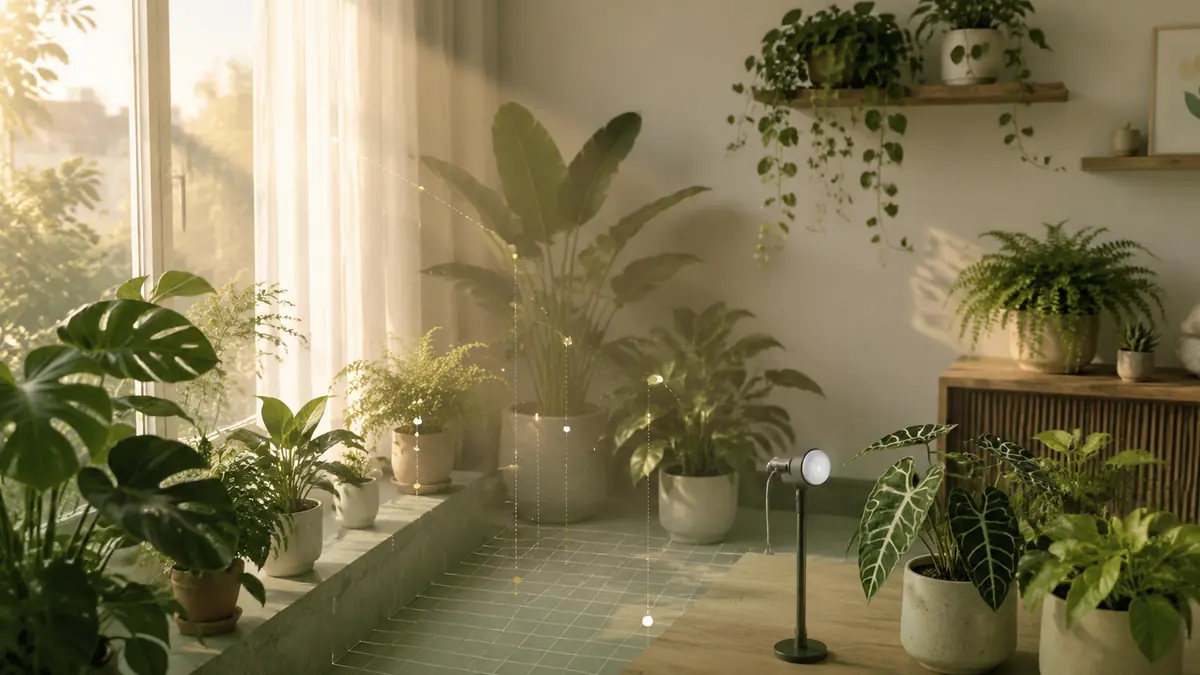
This is a broad estimate, not a PPFD measurement. Hemisphere, latitude, weather, glass, visible sky and time of day can still change the real light at the leaves.
Measure PPFD at leaf level when you need a stronger plant-specific decision.
How to evaluate East-Facing Window light
East-Facing Window Plant Finder exists to estimate a broad light category from window orientation plus distance, obstruction and filtering, then encourage leaf-level measurement for a stronger decision. The page focuses on natural houseplant light near a east-facing window and keeps the measurement, evidence and interpretation steps separate so a precise-looking value never hides weak biological evidence.
The most useful starting information is window direction, distance from glass, window size, exterior obstruction, curtain or blind filtering and season. These attributes describe either the plant, the light environment or the measurement context. PlantLightIndex uses them because houseplant light is not one universal label. A plant beside a window, a plant several metres into the room and a plant directly under a grow light can experience very different photon flux even when the room feels equally bright to a person.
The expected output is a broad natural-light category that is clearly labelled as an estimate. That output should be read as a decision aid, not as a guarantee of growth. The site is designed to answer the light question clearly while leaving unrelated care factors outside the result. Water availability, root condition, temperature, nutrition, pests and acclimation can all influence plant performance, so a correct light result is one environmental observation rather than a complete health diagnosis.
A east-facing label describes orientation, not PPFD. Latitude, solar angle, weather and the visible sky from the window all change the real result.
What a east-facing window tells you — and what it does not
A east-facing window mainly tells you orientation. It does not tell you the PPFD at a plant. The typical pattern is morning sun and a brighter first half of the day, but hemisphere, latitude, season, nearby buildings, trees, roof overhangs and the visible sky can change that pattern substantially. Treat direction as one input rather than a measurement.
The finder therefore returns a broad category instead of an exact species target. A plant on the sill can receive far more light than one several feet into the same room. Measure at leaf level when the placement matters, especially when direct sun enters for part of the day.
How distance changes light from a east-facing window
Indoor light usually falls as you move away from the glazing because the window occupies a smaller portion of the plant's visible sky and room surfaces absorb or redirect light. The decline is not one universal percentage per foot. Window dimensions, room geometry and exterior view all matter. A distance selector can therefore adjust an estimate, but it cannot replace a sensor.
Measure where the leaves will actually sit. Tall floor plants should be checked at several heights. A trailing plant can begin near the window and extend into a much darker zone. Re-measure after moving furniture or as seasonal sun angles change.
How curtains, blinds and exterior obstructions affect this window
A sheer curtain can diffuse direct beams while reducing total photon flux. Closed blinds or a heavy curtain can reduce light much more. Exterior obstructions such as balconies, neighbouring buildings and dense trees can make a nominally favourable orientation much dimmer than expected. The estimator therefore asks about filtering and obstruction instead of using direction alone.
If the plant depends on a narrow period of direct sun, a change in blind position can matter more than the daily average suggests. Record the setup you actually use. An estimator result based on open glass is not representative when the curtain remains closed most of the day.
Season and hemisphere matter for a east-facing window
Solar path changes through the year. Day length, solar elevation and the angle at which sunlight reaches the glass all shift with season and latitude. North-versus-south exposure also reverses between hemispheres. A global houseplant tool should not tell every user that one compass direction is automatically brightest.
Use the orientation page as a starting framework, then confirm with measurement. If a plant performed well in summer but slows in winter, compare PPFD at the same leaf position before changing unrelated care variables. Seasonal re-checking is especially useful near windows.
Which PlantLightIndex tool to use after the window estimate
If you only need a rough shortlist, send the estimated category to the Plant Light Matcher and keep the lower confidence in mind. If you can obtain a PPFD reading, use the Houseplant Light Calculator instead. That replaces a direction-based proxy with the light actually reaching the selected plant.
A grow light can supplement a weak window, but measure the combined setup at the leaves. Natural and artificial photons both contribute to the plant's light environment even though their daily patterns may differ. The goal is not to find a universally “good east-facing window”; it is to understand this plant position.
How evidence scope changes the answer
A numerical plant-light recommendation is only as specific as the evidence behind it. Exact-cultivar evidence applies most directly to a named cultivar. Exact-species evidence applies directly to a species record. A parent-species reference can provide useful context for a cultivar, while a genus-level reference is broader again. Those categories should not be presented as equivalent.
PlantLightIndex uses full, contextual and qualitative calculator modes. A full record contains a practical numerical reference suitable for direct comparison. A contextual record may show a related parent or genus range but explicitly labels it as context. A qualitative record explains what is known without generating an exact numerical target. This structure is especially important for variegated cultivars, where physiology can differ from a green parent.
Confidence is also shown. The confidence label reflects source quality, taxon match, direct measurement, agreement among independent evidence and relevance to indoor growing. It does not mean that a plant has a fixed percentage chance of success. The measurement itself can also have uncertainty, and individual plants can respond differently because of acclimation and growing history.
How to measure or enter the information correctly
Use values that describe the plant's real growing position. If PPFD is involved, measure at leaf level. For a small plant, one representative point may be useful. For a large specimen, take several readings across the canopy because the top, centre and outer leaves can receive different light. Record the light source and approximate time.
For grow lights, measure at the actual mounting distance and dimmer setting. Do not hold the sensor next to the fixture and assume the same value reaches the leaves. Beam angle, optics and distance change both intensity and coverage. Two lights using the same electrical wattage can produce very different PPFD at the plant.
For window light, remember that natural PPFD changes through the day. Direction, distance from glass, window size, season, latitude, cloud cover, buildings, trees and curtains can all change the result. A single midday measurement is a snapshot. Several readings provide better context when the daily pattern changes strongly.
When a tool uses an estimate rather than a measurement, PlantLightIndex labels that origin. Estimated window light and interpolated fixture values should not be displayed as if a quantum sensor measured them directly.
A practical example of how to interpret the result
Two plants in the same room can receive different light even though both are associated with the same east-facing window. One may sit on the sill while the other is several metres away behind a curtain.
The important lesson is to keep the calculation and biological claim separate. If a calculator produces a DLI of 6.48 mol/m²/day, that number follows mathematically from the entered PPFD and hours. It does not prove that 6.48 is an ideal DLI for every houseplant. If a chart shows a practical PPFD range, the upper edge is not automatically a damage threshold. If a window estimator returns “medium,” the label is still an estimate until a real measurement replaces it.
The same principle applies to experimental research. A plant surviving at a very low PPFD demonstrates tolerance under those study conditions. It does not establish the same intensity as an optimum for ornamental growth. A photosynthetic light-saturation point is a physiological benchmark, not necessarily a recommended household setting. A greenhouse production treatment answers a production question, which may differ from a living-room care question.
PlantLightIndex stores those contexts separately so the user can see what a value is actually evidence for.
What a trustworthy result on East-Facing Window Plant Finder should tell you
A useful result should identify the quantity being discussed, the origin of the value and the strength of the biological reference. On this page, the central focus is natural houseplant light near a east-facing window. The relevant inputs are window direction, distance from glass, window size, exterior obstruction, curtain or blind filtering and season. A user should be able to tell which of those values were measured, which were estimated and which came from the curated plant or fixture dataset.
The result should also preserve units. PPFD belongs in µmol/m²/s, DLI belongs in mol/m²/day, duration belongs in hours and fixture distance needs an explicit unit. A qualitative label such as bright or medium should never be displayed as though it were a sensor reading. If the page returns a broad natural-light category that is clearly labelled as an estimate, the explanation should state what that output can support and what it cannot prove.
Evidence language matters just as much as arithmetic. Exact-species evidence can support a more direct statement than genus context. A parent reference can be useful for a cultivar without becoming an exact cultivar target. An experimental observation should retain the study context. This is why PlantLightIndex places confidence and evidence scope near the result instead of hiding them in a methodology page.
When to revisit the measurement or comparison
Light environments change. Re-check after moving the plant, changing fixture height, adjusting a dimmer, moving curtains or blinds, replacing a grow light, rotating a large specimen, or entering a different season near a window. A growing plant can also move its newest leaves into a different light zone even when the pot never changes position.
Use the same measurement method when comparing before and after. Note the sensor position, time, light source and duration assumptions. If a result was based on an estimate, replace it with a measured PPFD when possible. If the biological record was contextual or qualitative, review the plant profile later because stronger species- or cultivar-specific evidence may change the recommendation status.
Keep the measurement chain intact
When you move from one PlantLightIndex tool to another, carry the original measurement details with the number. A PPFD value should remain tied to its leaf position and light source. A DLI value should remain tied to both PPFD and the hours used in the calculation. An interpolated fixture value should remain labelled as an estimate. This prevents a number from becoming more certain simply because it appears on a second page.
The same rule applies to plant evidence. If the plant record uses a genus or parent reference, that scope should remain visible in the calculator, chart and matcher. Changing the format from a profile to a table does not strengthen the underlying evidence. Consistent provenance makes different tools comparable without turning context into certainty.
What can make the result misleading?
Natural light varies through the day and year, so one direction-based estimate cannot replace a representative PPFD measurement.
Another source of error is plant identity. Common names can refer to different species, and older scientific names can remain popular long after taxonomy changes. Cultivars can also be mistaken for species. The plant database stores accepted scientific names, common names, synonyms and trade names separately so a search alias does not silently redefine the biological entity.
Measurement method matters too. A lux meter is not a universal PPFD meter. A phone sensor may be useful for relative brightness but can differ from a calibrated quantum sensor. Manufacturer PPFD maps can be useful when the test conditions are clear, but room reflections, fixture height and dimmer settings may differ from the published setup.
Finally, biological response is not perfectly sharp at one boundary. A reading one unit below a practical range is not meaningfully different from a reading one unit above it. Ranges are decision aids. Observe patterns over time and avoid treating care references as exact on/off thresholds.
How to use this information to make a change
Start by confirming the current light rather than changing several variables at once. If the measurement is clearly below an appropriate practical reference, you can move the plant closer to a suitable window, reduce shading, increase grow-light output, adjust fixture distance or consider a longer daily duration when a valid DLI framework exists.
If you increase light substantially, acclimate the plant. Leaves developed under dim conditions may respond differently to a sudden strong exposure. A gradual change also makes it easier to identify the cause of a response. After changing the setup, measure again at the leaves instead of assuming the adjustment produced the intended PPFD.
If the record is contextual or qualitative, keep the uncertainty in the decision. A genus-level range can tell you whether your environment is broadly plausible, but it should not be treated as an exact cultivar optimum. Use observable growth, leaf development and repeated measurements while stronger evidence is unavailable.
A east-facing label describes orientation, not PPFD. Latitude, solar angle, weather and the visible sky from the window all change the real result.
Common mistakes to avoid with East-Facing Window Plant Finder
The first mistake is looking for one universal number. Houseplants differ, cultivars can differ from their parent species, and the same plant can experience different canopy zones. The second mistake is confusing electrical watts, lux or visual brightness with PPFD at the leaves. The third is using a practical range as if it were a proven optimum or damage threshold.
Another mistake is ignoring time. PPFD does not include duration. DLI does, but DLI does not describe the exact intensity pattern used to reach the daily total. A user who changes fixture intensity and timer duration simultaneously can make it difficult to understand which variable caused the plant's response.
A final mistake is filling missing evidence with a convenient number from an unsourced page. PlantLightIndex intentionally displays “not established” when a precise plant-specific target cannot be defended. That blank is information. It tells the user the current evidence is weaker than the precision of the question.
How this page connects to other PlantLightIndex tools
East-Facing Window Plant Finder is part of a connected system rather than a standalone article. The plant database stores identity, PPFD references, evidence scope and confidence. The Houseplant Light Calculator compares a selected plant with a measured setup. The PPFD-to-DLI Calculator handles the objective light math. The Plant Light Matcher starts from an environment and finds compatible numerical records.
Window pages help users describe natural-light conditions when a PPFD measurement is not available. The grow-light database is designed to store verified fixture measurements at known distances and dimmer settings. Learn pages explain the underlying units and concepts so users can interpret the tools rather than treating them as black boxes.
The most relevant next steps for this page are:
Use internal links based on your current question. If you already have a measurement, move toward the calculator. If you are choosing a plant, move toward the database or matcher. If a unit is unclear, use the Learn guides first.
Document the setup so the result remains useful
A light value becomes much more useful when you can reproduce the conditions behind it. Record the plant or fixture identity, measurement position, PPFD origin, distance from the source, dimmer setting when relevant, and the hours used for any DLI calculation. For window measurements, add the approximate time and season. These details let you compare a later reading with the same setup instead of comparing two numbers collected under different conditions.
Good records also make uncertainty easier to spot. If one result came from a quantum sensor and another came from a broad window estimate, they should not be treated as equally precise. If the plant evidence changed from genus context to an exact-species reference, keep that distinction beside older notes. Measurement history is most valuable when provenance stays attached to the number.
Authoritative sources and measurement references
PlantLightIndex prioritizes peer-reviewed research, university extension, botanical institutions and established measurement references. Sources are used to support the concepts on this page, while plant-specific numerical claims remain tied to their own evidence records.
The page does not copy source wording. It uses those references to explain the measurement system, then keeps practical recommendations, physiology, production observations and estimates in their proper categories.