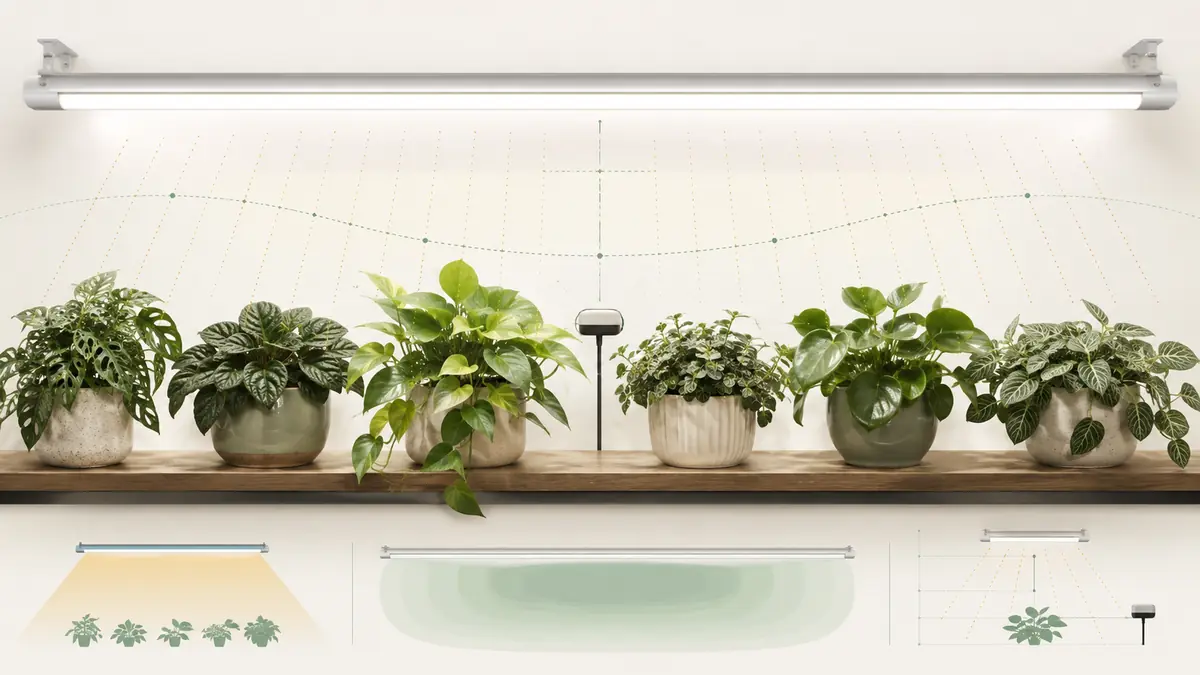
What the SANSI T8 15W data actually tells you
The useful question is not simply whether this is a “strong” grow light. The useful question is how much photosynthetically active light reaches a plant at a known distance, setting and measurement position.
PlantLightIndex records this fixture as multi-point PPFD data. Its listed electrical draw is 15 W, while manufacturer-listed PPF is 24 µmol/s. Those measurements describe different parts of the lighting system. Watts describe electrical input. PPF describes total photosynthetic photon output. PPFD describes photon density at a surface such as the top of a plant canopy.
Both points come from the current manufacturer page: 215.63 µmol/m²/s at 10 cm and 83.96 µmol/m²/s at 1 ft. Interpolation is limited to that measured span.
This distinction matters when a user searches for “T8 15W LED Grow Light distance for Monstera,” “T8 15W LED Grow Light PPFD,” or “how far should T8 15W LED Grow Light be from plants.” A wattage number cannot answer those questions by itself. PlantLightIndex only calculates a distance when numeric manufacturer measurements cover more than one distance and the requested result stays inside that published span.
T8 15W LED Grow Light specifications
| Brand | SANSI |
|---|---|
| Model | T8 15W |
| Fixture type | bar |
| Power | 15 W |
| PPF | 24 µmol/s |
| Spectrum | 4000K full spectrum |
| Color temperature | 4000 K |
| CRI | 95 |
| Beam angle | Not listed |
| Dimmable | No |
| Timer | No |
| Published measurement status | multi-point PPFD data |
These fields should be read as manufacturer-listed specifications at the time PlantLightIndex reviewed the source. They are not independent laboratory verification. Product revisions can change LED packages, optics, drivers or listed output while a familiar product name remains the same. That is why the source and research date matter.
Published PPFD measurements for this fixture
The current record contains 2 manufacturer-published PPFD points. PlantLightIndex can interpolate only between the closest published points; it does not extrapolate beyond them.
| Distance | Center PPFD | Dimmer | Measurement source |
|---|---|---|---|
| 3.9 inches | 215.63 µmol/m²/s | Fixed / not stated | manufacturer |
| 12 inches | 83.96 µmol/m²/s | Fixed / not stated | manufacturer |
The measured span currently runs from about 3.9 to 12.0 inches. Any distance shown by the finder stays inside that span.
Can PlantLightIndex calculate a grow-light distance from this data?
Yes, but only as an interpolation inside the published measurement span.
The distance finder compares the selected plant’s practical or contextual PPFD reference with the manufacturer points stored for this fixture. It then finds where an interpolated value overlaps that reference. It does not use electrical wattage to invent a curve, and it does not predict output beyond the nearest published endpoints.
Even when a distance range can be calculated, it is a starting point. Measure at leaf level after installation. A wall, reflective cabinet, multiple lamps, overlapping beams, fixture angle and plant canopy shape can all move the real PPFD away from the center reading in a manufacturer chart.
Why PPFD changes when you move the light
Moving a grow light farther from a plant usually lowers PPFD at the leaves because the emitted photons spread over a larger area. The exact decline is fixture-specific. A narrow optical beam can hold center intensity differently from a wide diffuse bar. A large panel does not behave exactly like a small point source. Reflective walls can also return some light to the canopy.
This is why PlantLightIndex stores distance + PPFD + dimmer setting + source as one measurement record. “PPFD 200” without a distance is incomplete fixture information. “36 watts” without photon output is also incomplete plant-light information.
If the light is moved closer, center PPFD may rise while the evenly lit footprint becomes smaller. A large Monstera can therefore have a well-lit center leaf and much dimmer outer leaves. Check more than one point across a wide canopy instead of placing the sensor only at the brightest spot.
PPF versus PPFD for T8 15W LED Grow Light
PPF and PPFD answer related but different questions. PPF is the fixture’s total photosynthetic photon output, normally expressed in micromoles per second. PPFD is the photon density landing on a square meter each second at a particular position.
The manufacturer lists this fixture at 24 µmol/s PPF. That value can help compare total output with another fixture, but it does not tell you how many of those photons reach one Monstera leaf at 18 inches. Beam angle, optics, distance and the size of the emitting surface determine how the total output is distributed.
For plant placement, a leaf-level PPFD measurement is usually more actionable than PPF alone. For evaluating overall fixture efficiency or comparing fixtures of different sizes, PPF can be valuable. Use both measurements for what they actually describe.
Does wattage tell you how strong this grow light is?
No. Wattage tells you how much electrical power the fixture draws, not the PPFD reaching a plant.
This fixture is listed at 15 W. Two grow lights with the same wattage can have different LED efficiency, PPF, beam angle, optics and thermal management. They can therefore deliver different PPFD to the same plant at the same distance. Conversely, a lower-watt narrow-beam bulb can produce a high center reading over a small area while a larger fixture spreads photons over a wider canopy.
Use wattage for energy consumption and electrical planning. Use PPF for total photon output when available. Use measured PPFD at the canopy for placement. PlantLightIndex keeps those attributes separate so one number is not silently used as a substitute for another.
How should you measure this light above a houseplant?
Place a quantum sensor at the height and orientation of the leaves you want to evaluate. Do not hold the sensor next to the fixture and then assume the same reading reaches the plant. For a broad plant, take readings near the center and around the outer canopy. For a shelf, measure under the middle of the bar and near the ends.
Record the fixture distance at the same time. Use a consistent reference such as the distance from the emitting surface to the leaf plane. If the fixture is dimmable, record the dimmer setting. If several fixtures overlap, note that the reading represents the combined setup rather than one lamp.
Repeat measurements after changing height, angle or dimmer level. If natural window light contributes during part of the day, measure the artificial-only setup separately when possible and then evaluate the combined environment at representative times.
How to compare this fixture with a plant’s PPFD reference
Start with the exact plant profile. A full PlantLightIndex record has a practical species-level PPFD reference. A contextual record may show a parent-species or genus reference, while a qualitative record deliberately has no exact number.
If a Monstera profile uses 150–250 µmol/m²/s as a practical reference, the goal is not to force every leaf to exactly 200. Use the range as evidence-aware context, measure multiple leaves, and watch how the plant responds after acclimation. If a cultivar has only a parent reference, the distance finder labels that result as contextual rather than pretending it is a cultivar-specific optimum.
Do not compare a manufacturer’s center PPFD to a plant reference without checking canopy coverage. The center may fall inside the target while the edges fall well below it. A wider beam or multiple fixtures can sometimes provide a more even environment than simply moving one strong bulb closer.
How many hours should this grow light run?
Distance and duration solve different parts of the lighting problem. PPFD describes instantaneous photon density. Photoperiod describes how many hours the light is available. DLI combines PPFD and duration into a daily photon total.
PlantLightIndex does not assign a universal 12-hour schedule to this fixture. The correct duration depends on the plant, the PPFD at its leaves, natural-light contribution and whether a credible plant-specific DLI target exists. If the plant record has no supported DLI target, the site can calculate your current DLI but will not classify an invented daily total as ideal.
Use the PPFD to DLI Calculator to see what a measured PPFD produces over your actual schedule. Use the grow-light-hours tool only where an evidence-backed target DLI exists.
What does dimming change?
This fixture is not listed as dimmable in the source used for this record, so PlantLightIndex does not generate lower-output settings.
A 50% control setting is not automatically proof that leaf-level PPFD is exactly half the 100% reading. Driver behavior and product design can affect the relationship. The database stores dimmer percentage on each measurement point so future test data can model that change directly.
If you use a dimmable fixture and only full-output manufacturer data is available, measure your actual setup at the chosen dimmer level. That measurement is more reliable than applying a percentage adjustment to the published chart.
Coverage matters as much as the center number
The manufacturer provides this coverage context: Manufacturer states 0.21 m² around the 10 cm high-intensity test. A center PPFD reading is not a complete map. A grow light can produce a high value directly below the fixture while dropping rapidly toward the edges. A wide bar or panel can have a lower center number than a focused bulb but illuminate a larger plant more evenly.
For one small plant, center intensity may be a useful starting point. For a large Fiddle Leaf Fig, climbing Monstera or grouped shelf, take readings at several points. The lowest meaningful leaf zones can matter as much as the highest. Rotating a plant can change exposure but does not replace adequate coverage.
PlantLightIndex will eventually distinguish center PPFD, average PPFD and mapped coverage where source data permits. Stage 8 starts conservatively with the numeric points that can be traced to a manufacturer source.
Can this fixture provide too much light?
Any sufficiently intense setup can place a plant above its practical indoor reference, especially when a focused grow light is close to the leaves. That does not automatically mean damage will occur. Plant acclimation, species, temperature, humidity and the actual damage threshold all matter.
PlantLightIndex therefore uses the phrase above our practical indoor reference when a measurement exceeds a reference range but no credible upper damage threshold exists. It does not label a fixture “too strong” simply because a center reading is high. You can lower PPFD by increasing distance, reducing dimmer output where supported, changing angle or using a wider beam.
After making a large light change, acclimate plants gradually when appropriate and observe the actual foliage. A calculator result is evidence context, not a guarantee of how one individual specimen will respond.
What the measurement confidence means
This fixture currently carries high fixture-data confidence. The label describes the quality and completeness of the fixture information in PlantLightIndex, not the quality of the product itself.
A high-confidence multi-point record has a current manufacturer source with several traceable distance measurements. Medium confidence may mean the distance points are sparse, combine a current product page with a manufacturer comparison guide, or omit important coverage details. A spec-only record can still have high confidence in its PPF or power specification while having no distance-finder capability.
If manufacturer pages disagree, PlantLightIndex should preserve the conflict instead of choosing the larger marketing number. This evidence policy mirrors the plant database: missing information stays missing until stronger evidence appears.
Who is this fixture type most useful for?
A bar fixture has practical installation characteristics that matter alongside photon output. A bar works naturally above shelves, cabinets and rows of smaller plants because its emitting surface is long and coverage can be more even across a shelf.
Choose a fixture based on the plant’s measured need, available mounting distance, desired coverage and room constraints. Do not choose only by the highest PPFD value in the database.
What spectrum and color temperature mean in this record
The manufacturer describes this fixture as 4000K full spectrum. Spectrum describes how photon output is distributed across wavelengths. Color temperature is a visual white-light descriptor, not a complete plant-action spectrum. A 3000 K lamp and a 5000 K lamp can both support photosynthesis, yet the exact spectral distribution and visual appearance can differ.
The listed color temperature is 4000 K. The listed CRI is 95. CRI describes how naturally colors appear to human vision. It is useful in living spaces because foliage and room colors can look more natural under a high-CRI source, but CRI does not measure photosynthetic efficiency. A light can have attractive color rendering and still deliver too little PPFD at the leaves if it is too far away.
For houseplant placement, first verify photon density at the canopy. Then use spectrum, color temperature and CRI to compare visual fit, plant response and room aesthetics. PlantLightIndex keeps these attributes separate rather than using “full spectrum” as proof that a fixture is automatically suitable at every distance.
How this fixture changes DLI over a daily schedule
A grow light contributes to daily light integral only while it is on. If the leaf-level PPFD were 100 µmol/m²/s for 12 hours, that constant artificial-light contribution would equal 4.32 mol/m²/day. If the same 100 PPFD ran for 8 hours, the contribution would be 2.88 mol/m²/day. These examples are arithmetic, not recommendations for this fixture or for a specific plant.
The fixture’s published PPFD points can therefore become useful after installation, but only when the actual leaf-level value is reasonably close to the published setup. A center reading from a manufacturer chart should not be multiplied by the entire photoperiod if most of the plant sits outside that intensity. Measure representative leaves, especially on wide canopies.
Natural daylight complicates the total because window PPFD changes continuously. In mixed lighting, treat the grow light as a controllable supplement and measure the combined environment when possible. The DLI guide explains why daily duration and instantaneous PPFD must be interpreted together.
Using T8 15W LED Grow Light on shelves, floor plants and grouped displays
The same fixture can behave very differently depending on geometry. A small shelf keeps the lamp close to the canopy and can make even a modest fixture useful. A tall floor plant may force a greater mounting distance, lowering PPFD but increasing the beam footprint. A grouped display adds another issue: one plant can shade another, so the fixture-to-pot distance is less useful than the fixture-to-leaf distance.
For a linear bar, measure along the length because end-of-bar intensity can differ from the center. Parallel bars can improve uniformity when shelves are wide.
When several fixtures overlap, measure the combined light with all lamps running. PPFD at the leaf is what the plant receives, regardless of how many fixtures create it.
How product revisions can change fixture data
Grow-light products can keep the same marketing name while manufacturers revise LEDs, drivers, optics, housings or regional versions. That can change PPF, electrical draw or the PPFD distribution. PlantLightIndex therefore records model wording, source URLs and measurement notes instead of assuming that every unit sold under a familiar name is identical forever.
Before using an old distance recommendation, compare your fixture with the current model page. Check wattage, model code, beam angle and control features. If your version differs, treat the stored curve as contextual until you measure the actual unit. This is particularly important for long-running product families and products sold in different voltage regions.
The database should be updated when a manufacturer publishes a revised specification. Older measurements should not simply disappear when they explain why users see different numbers elsewhere. Where possible, future PlantLightIndex records can preserve revision-specific measurement sets so a user can choose the model that matches the fixture they own.
What to check before buying or repositioning this light
Start with the plant, not the fixture. Identify whether the plant has a full numerical PPFD reference, a contextual parent or genus reference, or only qualitative guidance. Then check how much mounting distance your room actually allows. A fixture can have excellent output on paper but be difficult to use if the published useful span is much closer or farther than your shelf, ceiling or floor-plant setup permits.
Next, consider coverage. Ask whether one fixture can illuminate the canopy or whether multiple lights would create a more even field. Check whether the lamp is dimmable if your available mounting distance is fixed. Review spectrum and color temperature for a living space, but do not let visual brightness replace a PPFD measurement.
After installation, verify the result. Measure at leaf height, record the distance and schedule, and compare those values with the plant profile. If the plant has only contextual evidence, keep that uncertainty visible. The strongest setup is not the one with the highest specification; it is the one that delivers an appropriate, measurable environment across the actual plant.
How PlantLightIndex would improve this record
The best next evidence would be a reproducible PPFD map at several mounting distances and dimmer settings, with the measurement area, sensor position and test environment clearly described. That would let the site distinguish center intensity from average coverage and improve plant-to-fixture matching.
This record already has multiple distance points, so the next improvement is denser spacing and coverage mapping rather than extrapolation.
Independent measurements can later sit beside manufacturer data rather than replacing it. If the results disagree, users should be able to see which source, test geometry and product revision produced each value.
Sources and next steps
The fixture specifications on this page come from manufacturer material, which is the appropriate primary source for current model specifications. Manufacturer data is still not the same as independent verification. The page keeps the source visible so users can evaluate the claim and check for later revisions.