DLI for Houseplants
DLI, or daily light integral, measures the total amount of photosynthetically active light that reaches a square meter during one day. It combines light intensity with time, so it answers a different question than a single PPFD reading.
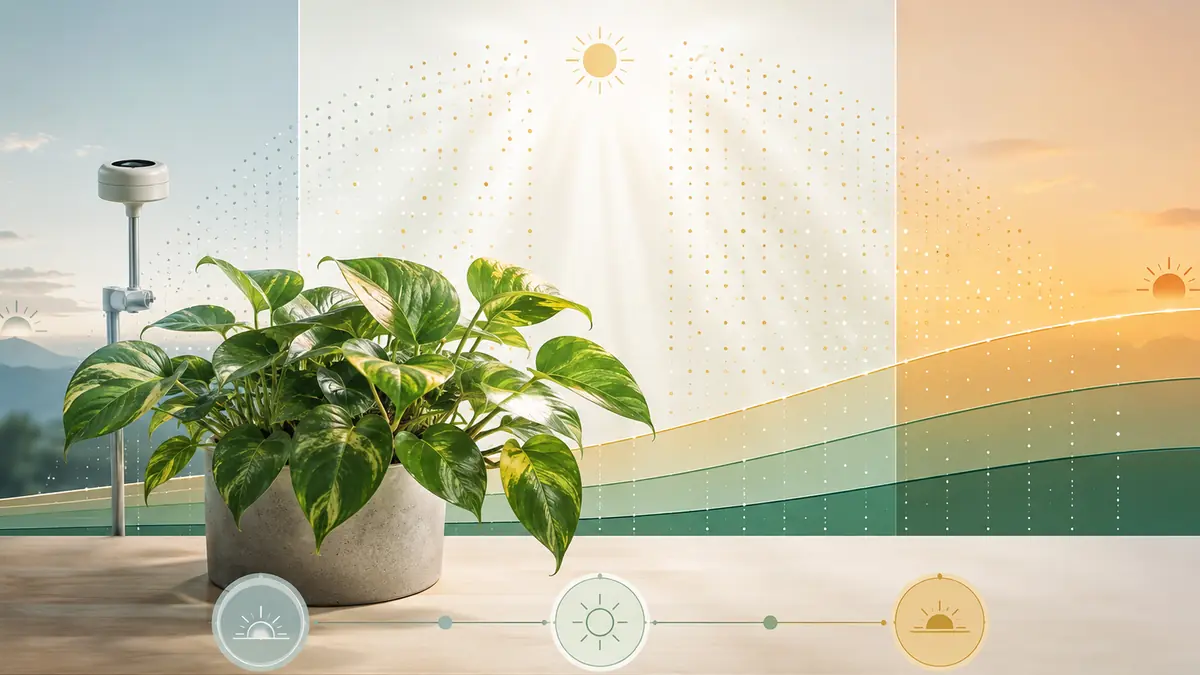
What Is DLI?
DLI is the total quantity of PAR photons received over a 24-hour day. PPFD tells you how intense the plant-usable light is at a moment. DLI adds the time dimension and describes the accumulated daily exposure.
DLI is expressed in moles per square meter per day, or mol/m²/day. A larger DLI means more PAR photons reached that surface during the day. It does not automatically mean the amount is appropriate for a particular plant. Interpretation still depends on species, cultivar, growth stage and evidence quality.
DLI is especially useful under grow lights because intensity and operating hours are often fairly stable. It can also describe natural light, but sunlight changes through the day, so a single midday reading is not enough to measure natural-light DLI accurately.
How Do You Calculate DLI From PPFD?
When PPFD is approximately constant, multiply PPFD by the number of light hours and by 0.0036.
PPFD is entered in µmol/m²/s. The result is expressed in mol/m²/day.
The factor 0.0036 converts seconds and micromoles into hours and moles. There are 3,600 seconds in an hour and 1,000,000 micromoles in one mole.
Example: 150 PPFD for 12 hours
150 × 12 × 0.0036 = 6.48 mol/m²/day.
The plant receives a calculated DLI of 6.48 mol/m²/day if the PPFD remains around 150 for those 12 hours.
Example: 100 PPFD for 10 hours
100 × 10 × 0.0036 = 3.6 mol/m²/day.
This calculation is mathematical. It does not say whether 3.6 DLI is sufficient for a specific plant unless a credible target exists for that plant or an explicitly labelled broader category.
What Is the Difference Between PPFD and DLI?
PPFD measures light intensity at a moment; DLI measures the total daily exposure. You need both intensity and duration to understand the amount of PAR a plant receives during a day.
| Measurement | What it answers | Unit |
|---|---|---|
| PPFD | How intense is the PAR light here right now? | µmol/m²/s |
| Photoperiod | How many hours is light available? | hours/day |
| DLI | How much PAR light arrived over the whole day? | mol/m²/day |
Can two setups have the same DLI with different PPFD?
Yes, mathematically. For example, 100 PPFD for 12 hours and 200 PPFD for six hours both calculate to 4.32 mol/m²/day.
What DLI Do Houseplants Need?
There is no single DLI target for every houseplant. Published guidance can provide broad indoor categories, while exact species and cultivar targets may be unavailable.
Iowa State University Extension provides broad categories for indoor plants and supplemental-light planning. It lists approximately 3–6 mol/m²/day as low light, 6–10 as medium light, 12–16 as high light, and 18–30 as very high light for groups of crops and indoor plants.
| Broad category | DLI | Example use in the source |
|---|---|---|
| Low | 3–6 mol/m²/day | Foliage houseplants |
| Medium | 6–10 mol/m²/day | Foliage and flowering houseplants, cuttings |
| High | 12–16 mol/m²/day | Flowering houseplants, succulents, some seedlings |
| Very high | 18–30 mol/m²/day | Herbs, fruits and vegetables |
PlantLightIndex does not copy these broad categories into every plant profile. A Monstera, Snake Plant and Fiddle Leaf Fig should not automatically receive the same DLI target just because they are all houseplants. When species-specific DLI evidence is not strong enough, the database shows Not established.
How Do You Measure DLI Accurately?
The most accurate DLI measurement integrates PPFD over the full day. A data logger can record repeated PPFD readings and add the photon exposure over time.
For a fixed grow light
If the grow light stays at approximately the same output and geometry for the whole photoperiod, a leaf-level PPFD reading multiplied by the operating hours gives a useful DLI estimate.
For a window
A single PPFD reading is not enough because sunlight changes with solar angle, clouds, shading and reflections. Measure at several times or use a logger if you need a reliable natural-light DLI. A noon reading multiplied by the full daylight period can substantially misrepresent the daily total.
For mixed window light and grow light
The daily photon exposure from both sources contributes to DLI. If a grow light supplements a window, measure the combined PPFD while both sources are active and account for periods when only one source is present.
How DLI Helps Set Grow-Light Intensity and Hours
DLI connects two controls you can change in many grow-light setups: PPFD and operating time. Increasing either one raises the calculated DLI. Reducing either one lowers it.
If a credible target DLI exists, you can rearrange the formula to estimate the required photoperiod:
This calculation should only be used as a plant-care recommendation when the target DLI itself is evidence-backed.
PlantLightIndex intentionally prevents the Grow Light Hours Calculator from inventing an answer when a plant-specific DLI target is missing.
Can you compensate for low PPFD by running the light longer?
Increasing duration raises DLI, but it is not an unlimited substitute for intensity. Plants can respond differently to long photoperiods, and some flowering responses depend on day and night length. Use duration as one part of a complete light plan, not as a universal workaround.
How Does Window Direction Affect DLI?
Window direction changes when and how strongly sunlight reaches a room, but direction alone does not determine DLI. Latitude, season, nearby buildings, trees, glass, window size, curtains and distance from the window can all change the daily photon total.
A south-facing window can provide much more daily light than a north-facing window in many Northern Hemisphere locations, but even two south-facing windows can produce very different leaf-level DLI. A deep overhang or neighboring building may remove hours of direct sky exposure.
Use the window pages for an initial placement estimate, then measure PPFD if the decision matters.
Common Questions About DLI
Is DLI the same as hours of light?
No. Hours describe duration only. DLI includes both duration and PPFD. Twelve hours of weak light and 12 hours of strong light have different DLI values.
Is a higher DLI always better?
No. Plants differ in their ability to use daily light. A higher DLI can exceed the practical needs of a shade-adapted plant or an unacclimated plant. More light can also change water use and leaf temperature.
Can I calculate DLI from lux?
You first need a spectrum-appropriate conversion from lux to PPFD. There is no universal conversion factor for every light source. Once PPFD is estimated, it can be used in the DLI formula.
Does DLI include the dark period?
DLI is expressed per 24-hour day, but only periods with PAR contribute photons. Darkness contributes zero to the total.
What is a good DLI for Monstera or Pothos?
PlantLightIndex does not currently assign a species-specific DLI target unless the reviewed evidence supports one. Broad category ranges can provide context, but they are not automatically promoted to a precise species recommendation.
Use DLI With Evidence, Not as a Standalone Score
DLI is valuable because it combines intensity and time in one daily measurement. The calculation itself is objective. The care interpretation is plant-specific. Use a measured PPFD, calculate the daily exposure, and then check whether PlantLightIndex has enough evidence to interpret that DLI for the exact plant.
How to use DLI in a real houseplant setup
The most useful way to apply DLI is to connect the concept to a real plant position, a defined light source and a measurement taken where the leaves receive light. DLI is most useful when intensity and duration both matter, especially under stable timed grow lights.
Estimate DLI from representative PPFD and light hours only when the PPFD reasonably describes the period, or use logged measurements for changing natural light. Record the value, the time or daily duration, and any important setup details such as distance from a grow light, window direction, curtain filtering or dimmer setting. Those attributes make the reading repeatable and easier to compare after a change.
Do not treat one number as the entire care plan. Light is one environmental variable. Water availability, temperature, humidity, nutrition, root health and acclimation influence how a plant responds. Use DLI to evaluate the light question, then observe the plant over time.
How to interpret mol/m²/day without false precision
A measurement unit is useful because it gives the observation a defined meaning, but biological response does not switch at perfectly sharp boundaries. A reading one unit above or below a practical reference should not be treated as a completely different condition. Measurement error and natural plant variation are often larger than that difference.
DLI is a daily total. It does not replace PPFD because the same DLI can be produced by different intensities and durations. PlantLightIndex therefore distinguishes measurements, practical references, physiological benchmarks and contextual ranges. A value from a controlled study stays linked to the conditions of that study instead of being silently promoted into a universal household target.
When a species-specific or cultivar-specific target is missing, the correct output is uncertainty. “Not established” is more useful than a precise number that cannot be defended. That rule protects the meaning of the values that are published.
Natural window light and artificial light can produce different patterns
Window light changes with solar angle, season, latitude, cloud cover, nearby buildings, trees, window size, glass and distance from the window. A single midday reading describes one moment. It may not represent the morning, afternoon or total day.
A grow light on a timer can be more stable, but fixture geometry still matters. PPFD can vary across the beam and across a large canopy. Moving a fixture closer often increases centre intensity while reducing even coverage. Dimmer settings can change output, and manufacturer measurements may use a different room or test geometry.
For either source, measure at the foliage. If a large plant spans several light zones, take several readings. This turns DLI from an abstract term into a description of the plant's actual environment.
Common measurement and interpretation errors
A common DLI mistake is multiplying one peak window reading by the entire daylight period. Another common error is measuring at a convenient location rather than at the leaves. A reading directly beside a fixture, on a desk, or at soil level may not represent the active canopy.
Users also sometimes mix units. Lux, foot-candles, PPFD, PPF and DLI describe different attributes. A conversion can be valid only when the relationship and spectrum are known. Label the original unit clearly and avoid changing it into another measurement just because a care guide uses different terminology.
Finally, avoid adjusting several major lighting variables at once. If you move the plant, raise the fixture and extend the timer on the same day, you may not know which change produced the response. Change the setup deliberately, then remeasure.
How distance, angle and coverage change what the plant receives
Light measurements belong to a position, not just to a fixture or window. Moving a sensor closer to a grow light usually changes the reading because the same emitted photons are distributed differently across space. Moving sideways can change the result too, especially under fixtures with a narrow beam or uneven diode layout. A plant with broad foliage may therefore receive a range of values rather than one canopy-wide number.
Angle matters because leaves intercept light on surfaces that are not always horizontal. A meter reading taken flat at one point may not match the orientation of every leaf. For practical houseplant use, the goal is not to model every leaf perfectly. The goal is to take representative measurements in the active canopy and understand where the brightest and dimmest zones occur.
Coverage is just as important as peak intensity. A fixture that produces a very high central reading over a small area may be less useful for a wide plant than a fixture that produces a more moderate but even PPFD across the canopy. This is why PlantLightIndex treats fixture distance and measurement maps as related to, but separate from, a plant's light target.
How to compare readings over time
A useful light record should be repeatable. If you want to know whether a change helped, measure in approximately the same canopy position and under the same fixture or window conditions. Record enough context to understand why two readings might differ. For grow lights, note the distance and dimmer setting. For windows, note the time, season and whether direct sun was present.
Do not overreact to very small differences. Meters have measurement uncertainty, hand position can shift, and natural light can change while you are taking the reading. Look for changes large enough to matter in the context of the plant reference rather than treating every single-unit difference as biologically meaningful.
Long-term plant response also matters. New leaf size, spacing, colour and growth rate can provide context, but those observations are not specific to light. Use them with measurements instead of replacing measurements with symptoms. The strongest workflow combines a defined unit, a repeatable measurement position, an evidence-aware reference and observation over time.
A practical checklist before you change the light
- Confirm the plant identity, including cultivar when relevant.
- Measure or estimate the light at the active leaves.
- Keep the original measurement unit visible.
- Record daily light duration when it affects the question.
- Check whether the plant reference is exact, contextual or qualitative.
- Separate a practical care range from physiology or survival observations.
- Make one useful adjustment and allow the plant to acclimate.
- Measure again after the setup changes.
Use DLI to compare daily exposure, but only classify it as suitable when the selected plant has a supported DLI reference.
When you already have a PPFD reading and daily duration, use the Houseplant Light Calculator. If the main question is the daily photon total, use the PPFD to DLI Calculator.