SANSI BR30 30W Remote
42 µmol/s PPF · 30 W. Measure PPFD in your setup before treating it as a plant match.
Review fixture evidence →Compare measured grow-light curves with the plant’s practical PPFD reference, then verify the real canopy instead of buying by wattage alone.
The strongest PlantLightIndex choices are fixtures whose published PPFD curves actually cross the 150–250 PPFD practical reference somewhere inside the measured span.
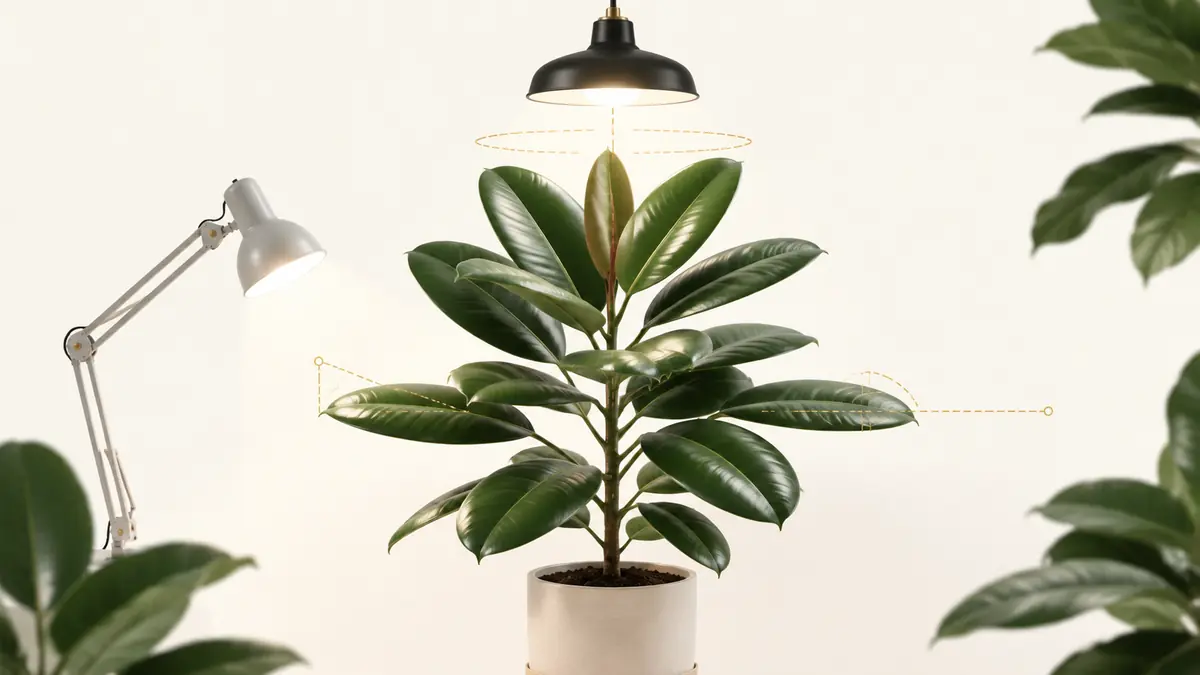
Rubber Plant is another exact-species record with a practical 150–250 PPFD indoor reference. Its broad, glossy leaves make measurement straightforward, but a tall Ficus elastica can develop the same vertical-coverage problem as a Fiddle Leaf Fig. Fixture selection should therefore consider where the active leaves sit, not just the height of the pot.
That wording matters. “Best” on this page means best supported by the current measurement dataset for this specific light reference. It does not mean every other grow light is inferior, and it does not mean the first item is universally best for every room. A fixture can have excellent electrical efficiency, build quality or coverage and still remain unranked here when the manufacturer has not published enough PPFD-distance data for the comparison.
The table below is generated from the same fixture measurements used by the Grow Light Distance Finder. The distance range appears only when the fixture curve crosses the plant reference between stored measurement points. The engine never extends the curve beyond the closest or farthest published point.
| Fixture | Matched distance | Measurement confidence | Why it appears |
|---|---|---|---|
| SANSI T8 15Wbar · 15 W · EU | 3.9–7.9 ininside published span only | high | This range is interpolated only inside the manufacturer-published measurement span. Verify at leaf level because coverage and room reflections can change the result. |
| SANSI BR30 36Wbulb · 36 W · US/CA/EU/UK | 14.5–28.5 ininside published span only | limited | This range is interpolated between widely spaced manufacturer endpoints. Treat it as a starting range and verify PPFD at leaf level. |
| SANSI BR30 24Wbulb · 24 W · US/CA/EU/UK | 12–17.8 ininside published span only | limited | This range is interpolated between widely spaced manufacturer endpoints. Treat it as a starting range and verify PPFD at leaf level. |
| SANSI PAR25 15Wbulb · 15 W · US/CA/EU/UK | 12–12.5 ininside published span only | limited | This range is interpolated between widely spaced manufacturer endpoints. Treat it as a starting range and verify PPFD at leaf level. |
A wide distance range can make a fixture easier to position, but width alone is not proof of better performance. Several SANSI bulb curves in the launch database use widely spaced manufacturer endpoints, so PlantLightIndex labels their interpolation as limited confidence even when the numerical overlap is broad. By contrast, a shorter span supported by closer measurement points can carry higher confidence.
A medium-output bulb can be effective for a young Rubber Plant, while taller branching specimens may benefit from a pendant, broader fixture or more than one directional source. Dimming can help when the plant sits in a fixed decorative location. PlantLightIndex favors fixtures with traceable PPFD-distance data because actual output varies too much for wattage to function as a reliable proxy.
The ranking starts with the plant record. A full plant profile has a practical numerical PPFD reference that PlantLightIndex is willing to use directly. A contextual profile may have a parent-species or genus range that helps frame a setup but is not an exact target for the selected cultivar or species. A qualitative profile does not enter numeric fixture ranking at all unless a suitable numerical context is explicitly stored.
The second layer is the fixture record. A grow light needs at least two compatible PPFD measurements at known distances before the distance engine can interpolate between them. PPF, wattage, lumens and marketing phrases such as “full spectrum” remain useful attributes, but they cannot replace a leaf-level intensity curve. That protects users from a common mistake: assuming two fixtures with the same wattage must produce the same PPFD at the same distance.
The third layer is geometry. Center PPFD does not describe every leaf. Beam angle, canopy width, fixture orientation and room reflections affect how photons are distributed. A product can cross the plant reference in the center and still provide poor edge coverage. For that reason, the final step is always a real measurement across the plant.
Measure the top leaves, side leaves and any lower foliage you want to retain. Broad leaves can shade one another, especially when the lamp is directly overhead. A small change in angle can sometimes improve the lower canopy more effectively than increasing total output. Re-measure as the stem elongates toward the lamp.
Distance is measured from the light-emitting surface to the leaf plane being evaluated, not to the tabletop, floor or pot rim. If a plant is tall, “the distance” can be different for every leaf. Record the closest leaf and representative outer leaves. When the canopy has a large vertical range, a single overhead lamp may require compromises between top intensity and lower-canopy coverage.
Always separate a starting range from a final installation. Manufacturer measurements are usually collected under a particular test geometry. Your walls, reflective surfaces, shade, fixture housing and plant shape can change the reading. Move the fixture gradually, then verify PPFD at leaf level before changing the daily schedule.
Bulbs suit compact single-stem plants. Pendants are easy to position over a floor plant. Bars work better when several Rubber Plants share a shelf or when supplemental side light is needed. Panels can provide broad coverage, but a panel with one center PPFD point remains a spec-only candidate rather than a calculated distance match.
Bulbs are inexpensive to integrate into adjustable lamps and are easy to aim at a single plant. Their main limitation is beam geometry. A high center reading does not guarantee broad coverage, and large bulbs can be heavy enough to require a stable fixture.
Bars spread light along a line, which can be useful for shelves, vines, propagation stations and rows of small plants. Their short mounting distance can be an advantage in cabinets but less convenient for tall floor plants.
Pendants work well when appearance matters and the plant sits in a permanent display position. Their usable intensity depends on hanging height and optics. A stylish light is still a grow light only when measurable plant-usable photons reach the leaves.
Panels can provide broader output for large canopies or collections. However, PlantLightIndex does not invent a distance curve when only one center PPFD point is published. Those fixtures remain visible as specifications you can measure yourself.
A Rubber Plant in a bright room may receive good window light in summer and noticeably less in winter. Instead of moving it back and forth, a measured grow light can provide a stable supplement. Use the fixture matcher to find a published-distance overlap with 150–250 PPFD, then verify the canopy at the season when natural light is weakest.
Once the fixture is installed, write down four values: plant identity, PPFD at representative leaves, fixture-to-leaf distance, and daily light hours. Those four values make future adjustments far more useful than notes such as “moved lamp closer.” If a new leaf develops differently after a change, you can connect that observation to a measurable setup.
Do not change intensity and duration dramatically at the same time unless you are correcting an obvious problem. Gradual adjustments make it easier to distinguish acclimation from stress and to understand which change actually affected the plant.
Rubber Plant often begins as a single upright stem and later branches, so the appropriate fixture can change with pruning and maturity. A directional bulb may cover a young plant very well, but after branching the crown can become wider than the beam. Broad glossy leaves can also shade lower growth. Measure the active upper canopy and any lower leaves you want to keep, then decide whether the issue is intensity or spread. If the plant sits next to a bright window, supplemental lighting may be most useful on the shaded side rather than directly overhead. Seasonal window changes can alter that balance. Re-check the setup during the darkest part of the year before buying a larger fixture; the existing light may only need repositioning or a slightly longer measured supplement.
That is why PlantLightIndex treats fixture matching as an ongoing measurement process rather than a one-time purchase decision. Plant size, canopy position and mounting distance change. The fixture record can remain the same while the real PPFD at the leaves moves considerably.
Electrical watts describe how much power a fixture consumes. They do not directly tell you how many photosynthetically active photons reach a square meter of leaf surface each second. LED efficiency, lens design, reflector geometry, beam angle and mounting distance can cause two similarly powered products to produce very different PPFD at the plant.
PPF adds another useful specification. It describes the total photosynthetic photon flux produced by the fixture in micromoles per second. PPF is useful when comparing how much PAR a fixture emits overall, but it still does not describe where those photons land. PPFD adds area and therefore becomes more useful for positioning a plant under a particular fixture.
This is why PlantLightIndex can store a powerful spec-only panel without claiming a plant distance. A manufacturer might publish wattage and PPF accurately while providing only one PPFD point. The database can show all three values and still say, “measure the fixture at your leaves.”
PPFD is instantaneous. Daily light integral, or DLI, adds duration. A constant 100 PPFD for 12 hours contributes 4.32 mol/m²/day. The same 100 PPFD for eight hours contributes 2.88 mol/m²/day. These are mathematical examples, not plant-specific recommendations.
PlantLightIndex does not currently have a locked DLI target for every plant on these commercial pages. Therefore, it does not calculate an “ideal” daily runtime merely because the fixture crosses a PPFD reference. If your plant also receives window light, the grow lamp may be supplementing a changing natural-light profile rather than supplying the whole day.
Use a consistent timer for repeatability, but choose the schedule from the whole light environment. A longer photoperiod cannot always compensate for extremely weak intensity, and more hours are not automatically better. Plants also require a normal dark period for physiological processes.
A PPFD number printed on a product page is often a center measurement. Center measurements are useful for comparing distance, but they do not tell you the average PPFD over a broad canopy. A narrow optical lens may produce a strong number in the middle while intensity falls rapidly a few inches away.
For one small plant, a centered beam may be perfectly practical. For a large specimen, several plants, or long trailing foliage, coverage becomes a first-class variable. Measure the middle and edges. If outer leaves receive substantially less light, raise the fixture for a wider footprint, use a different optic, or add another source rather than simply increasing the center intensity.
This is also why PlantLightIndex avoids converting PPF into a single PPFD estimate. Total photon output can be distributed across very different areas depending on fixture design.
They are not automatically poor choices. They are simply not eligible for a measurement-based distance recommendation yet. Current spec-only or single-point records in PlantLightIndex include products with useful information such as PPF, power, spectrum, dimming and one center measurement.
42 µmol/s PPF · 30 W. Measure PPFD in your setup before treating it as a plant match.
Review fixture evidence →47.18 µmol/s PPF · 30 W. Measure PPFD in your setup before treating it as a plant match.
Review fixture evidence →105 µmol/s PPF · 70 W. Measure PPFD in your setup before treating it as a plant match.
Review fixture evidence →150 µmol/s PPF · 100 W. Measure PPFD in your setup before treating it as a plant match.
Review fixture evidence →If you already own one of these fixtures, the fastest way to make it useful is to measure PPFD at several distances and canopy positions. You can then use the Houseplant Light Calculator without waiting for PlantLightIndex to publish a manufacturer curve.
The practical reference does not prove that stronger light is automatically harmful. Rubber Plants can acclimate to brighter environments. If your measured PPFD is above the current indoor reference, PlantLightIndex treats that as a reason to observe and verify—not as an automatic diagnosis of excess light.
The site also avoids a second form of false precision: ranking products by features that do not have the same importance for every user. A timer is convenient but does not make a weak fixture stronger. A warm color temperature may look better in a living room but does not prove higher PPFD. A large PPF value may indicate greater total photon output while telling you little about a particular leaf until area and distance are known.
Use this page as an evidence-filtered shortlist. It narrows the products to setups that can be defended with current data. Your meter and your plant remain the final validation.
PlantLightIndex currently uses a practical 150–250 PPFD indoor reference for Ficus elastica.
Use a fixture with measured output that overlaps the plant reference at the real canopy distance and provides enough spread for the leaves.
Yes. Bulbs can work especially well for smaller specimens when aimed securely and measured at leaf level.
A panel may improve coverage, but PlantLightIndex will not calculate an exact distance unless the panel has a usable multi-point PPFD curve.
If you want to compare another plant without reading a new buying guide, use the Grow Light Plant Matcher. It runs the same measured-data logic across every plant with a numerical or contextual reference.
Plant recommendations and fixture specifications are sourced separately. Plant sources establish identity or lighting context. Fixture pages preserve manufacturer measurement points and data limitations. A commercial recommendation appears only where those two layers can be compared without inventing missing values.